



Vallejo RAF Day Fighters paint set | Pre-War to 1941
Couldn't load pickup availability
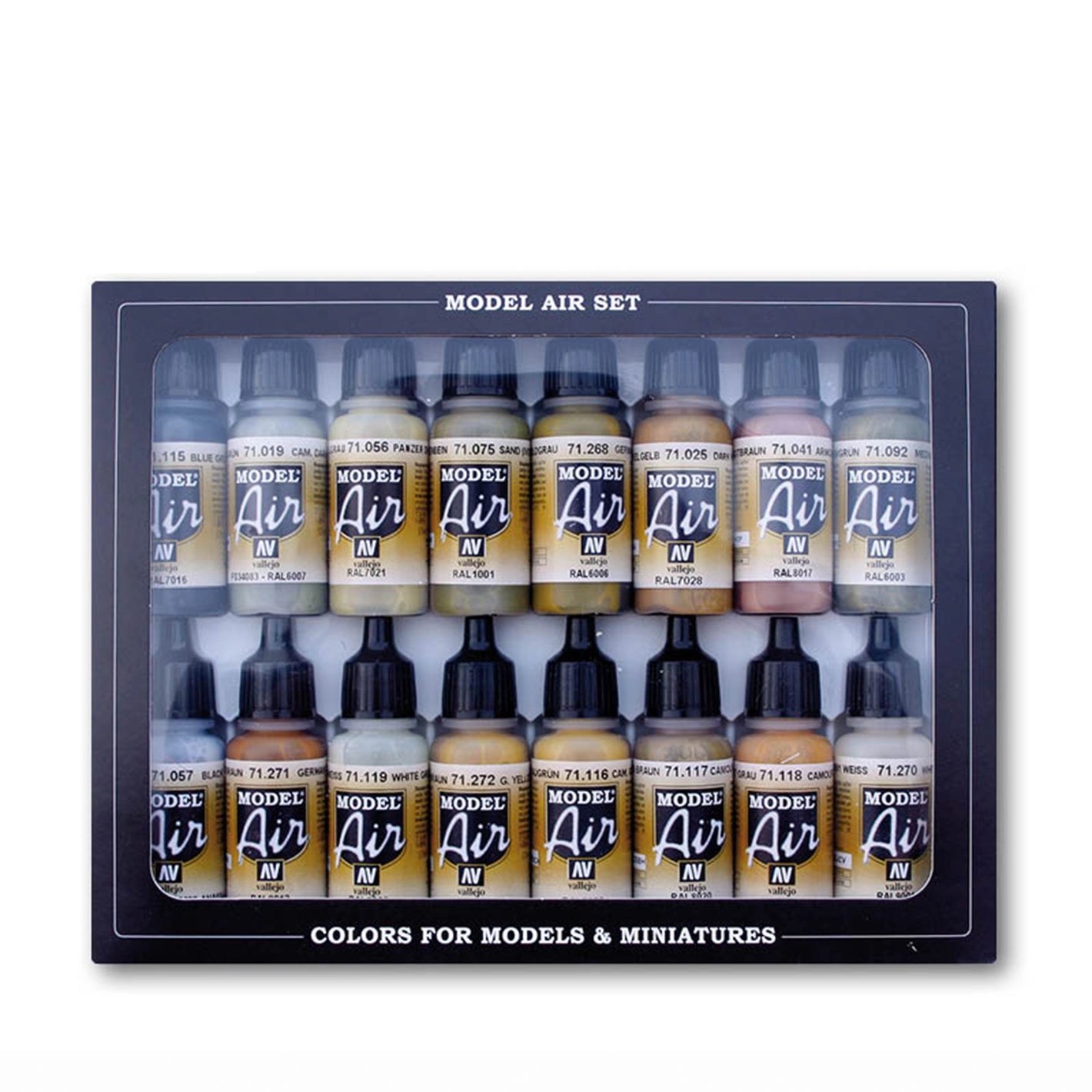


Battle of Britain & Early-War RAF Aircraft Color Palette
The Vallejo RAF Day Fighters Paint Set 71.149 is built for modelers recreating RAF fighter camouflage from the years before World War II through the first major campaigns of the conflict, including Norway, the Netherlands, France, England, and the Battle of Britain.
Vallejo’s official description places this set around the Temperate Land scheme and notes that it also includes the colors needed for Shadow Compensation finishes used on biplanes. Reference 71.149 and store SKU 71149 should stay visible in the copy and metadata because exact-code shoppers often search by set number as much as by theme.
What makes the Vallejo RAF Day Fighters paint set more useful than a loose group of RAF colors is that it brings together the key dark earth, dark green, underside, highlight, and support tones needed to handle both standard day-fighter camouflage and related early-war variations.
Because the paints belong to the Model Air line, they are airbrush-ready acrylics intended for smoother application, controlled layering, and cleaner camouflage transitions on aircraft kits in common scales. A retailer description also notes that the set was developed through color matching to Federal Standard 595 and British Standard BS381C, and that it features aircraft profiles by Mark Rolfe.
The Vallejo RAF Day Fighters paint set is especially practical for modelers who want to work across more than one RAF subject from this period. Instead of buying individual bottles one by one, the set provides a compact early-war palette suitable for Spitfire Mk.I and Mk.II, Hurricane Mk.I, Gloster Gladiator, Boulton Paul Defiant, Bristol Blenheim, and related support aircraft.
Why Choose the RAF Day Fighters Paint Set?
The EDSG scheme — Earth, Dark Green, Sky — is one of the most reproduced WWII camouflage patterns in scale modeling. These colors match the BS381C British Standard specifications used for RAF fighter camouflage, helping modelers reproduce authentic RAF aircraft finishes with greater historical accuracy.
- Historically focused palette: Designed around RAF Temperate Land camouflage from 1937 to August 1941.
- Shadow Compensation support: Includes tones intended for biplane shadow-compensation finishes as noted by Vallejo.
- Airbrush ready: Model Air paints are pre-prepared for smooth airbrush application.
- Reference-friendly buying: Keeping 71.149 / 71149 in the page helps support exact-reference searches.
- Broad early-war usefulness: Covers multiple RAF fighter subjects and related early conflict theaters.
Included Colors & Historical References
Color Reference Numbers & British Standard Codes
This set includes 8 × 17ml / 0.57 fl oz Model Air bottles. The color list below matches Vallejo’s official product page and current retailer listings, while the added-use column gives extra value beyond the core set theme.
| Ref. Number | Color Name | Historical Set Use | Additional Modeling Use |
|---|---|---|---|
| 71.323 | BS Dark Earth | Main upper-surface brown in RAF Temperate Land camouflage | Also useful for dusty earth weathering, fabric control surfaces, field equipment, and brown-toned groundwork on early-war dioramas. |
| 71.324 | BS Dark Green | Main upper-surface green in RAF camouflage | Useful on RAF and Commonwealth vehicles, green field accessories, camouflage touch-ups, and mixed military projects where a dark service green is needed. |
| 71.291 | US Earth Yellow | Lighter earthy tone used for early-war tonal balance and set variation | Helpful for fading effects, dust modulation, worn ochre fabric tones, and sun-lightened upper camouflage transitions. |
| Note: “US Earth Yellow” is Vallejo’s Federal Standard 595 reference name for the earth yellow tone used in pre-war RAF camouflage schemes before BS Dark Earth was formally adopted as the standard. Despite the “US” prefix, this color supports British pre-war and early-war earth-tone transitions. | |||
| 71.403 | Light Green | Shadow Compensation and lighter green compensation areas | Also works for lighter camouflage modulation, soft highlight blending, interior fabric adjustments, and greener field details. |
| 71.302 | Sky Type S | Lower-surface and recognition tone in RAF applications | Useful for undersides on other RAF subjects, pale green-blue modulation, and soft faded lower-airframe adjustments. |
| 71.279 | Insignia White | Light support tone and high-value contrast within the set | Useful for roundel preparation, highlight mixing, stencil corrections, fabric lightening, and subtle fading effects. |
| 71.057 | Black | Recognition areas, depth, and contrast support | Useful for preshading, propeller details, tires, exhaust deepening, panel definition, and mixing darker camouflage accents. |
| 71.062 | Aluminium | Metallic details and exposed metal areas | Useful for panels, chipped edges, prop hubs, metal fabric aircraft details, and silver-dope style finishes on selected parts. |
Application Guidelines for Early RAF Aircraft
To paint a Battle of Britain Spitfire, use BS Dark Earth (71.323) and BS Dark Green (71.324) on upper surfaces, Sky Type S (71.302) on undersides, with Aluminium (71.062) for metal-finish areas and undercarriage details.
The 71.149 palette is built for the RAF’s front-line fighters of the Battle of Britain: the Supermarine Spitfire Mk.I and Mk.II and the Hawker Hurricane Mk.I. BS Dark Earth and BS Dark Green cover the standard upper-surface EDSG camouflage pattern introduced in 1937, while Sky Type S handles the distinctive pale blue-green undersurface.
- Prime first: Use a suitable primer before airbrushing so the lighter colors and camouflage transitions stay clean and consistent.
- Build the upper camouflage gradually: Apply BS Dark Earth and BS Dark Green in thin passes to preserve panel lines and fine surface detail.
- Handle undersides separately: Use Sky Type S and related lighter tones carefully for lower surfaces and softer contrast zones.
- Use lighter tones for compensation and fading: Light Green, Insignia White, and Earth Yellow are useful for subtle tonal adjustment and scale effect.
- Clean the airbrush between shifts: Early RAF schemes often require multiple tonal transitions, so regular cleaning helps maintain sharper edges.
Expert Tips for RAF Pre-War and Early-War Modeling
- Do not over-flatten the camouflage: Temperate Land schemes look better when the brown and green show slight tonal life instead of one dead, uniform finish.
- Use Aluminium selectively: It works well for exposed metal details, but also for restrained wear on service panels and cockpit-adjacent parts.
- Keep Black as a utility tone: Beyond recognition areas, it helps with preshading, contrast control, and darkening mixes without opening another bottle.
- Use the set beyond fighters: The palette can also support trainers, support aircraft, and selected diorama accessories from the same period.
Expanding your RAF modeling beyond the early-war period? Browse the Vallejo WWII Air Forces Sets collection for Luftwaffe, RAF, USAAF, and other theater-specific aircraft palettes.
Frequently Asked Questions — Vallejo RAF Day Fighters Paint Set 71.149
What colors are included in the Vallejo 71.149 RAF Day Fighters set?
The set contains 8 × 17ml Model Air bottles: BS Dark Earth, BS Dark Green, US Earth Yellow, Light Green, Sky Type S, Insignia White, Black, and Aluminium.
What aircraft is this set designed for?
The set is built around early-war RAF fighters, especially the Supermarine Spitfire Mk.I and Mk.II and the Hawker Hurricane Mk.I. The colors also apply to Boulton Paul Defiant, Bristol Blenheim, Gloster Gladiator, and related RAF aircraft through 1941.
What is the EDSG camouflage scheme?
EDSG refers to Earth, Dark Green, and Sky, the standard RAF day fighter camouflage pattern used through the Battle of Britain and into 1941. This set includes the core colors needed for that scheme.
Why is US Earth Yellow included in an RAF paint set?
US Earth Yellow is Vallejo’s Federal Standard 595 reference name for an earth yellow tone useful in pre-war RAF camouflage transitions. Despite the “US” prefix, it helps support the historical color range needed for early RAF subjects.
Is this set airbrush-ready?
Yes. Vallejo Model Air paints are pre-thinned for airbrush use straight from the bottle. For finer detail work, add 10–15% Vallejo Airbrush Thinner and start around 15–18 PSI for base coats.